
Territorial scale
Recognising a landmark
Visibility depends on viewpoint, vegetation, the route taken and urban transformation. Today’s landscape guides the question, but does not reproduce pre-Hispanic experience exactly.
How stones ‘speak’ · 05
A natural formation can be seen, remembered or ignored without having been carved. The challenge is to distinguish geological origin, landscape experience and cultural meaning.
Formation and experience
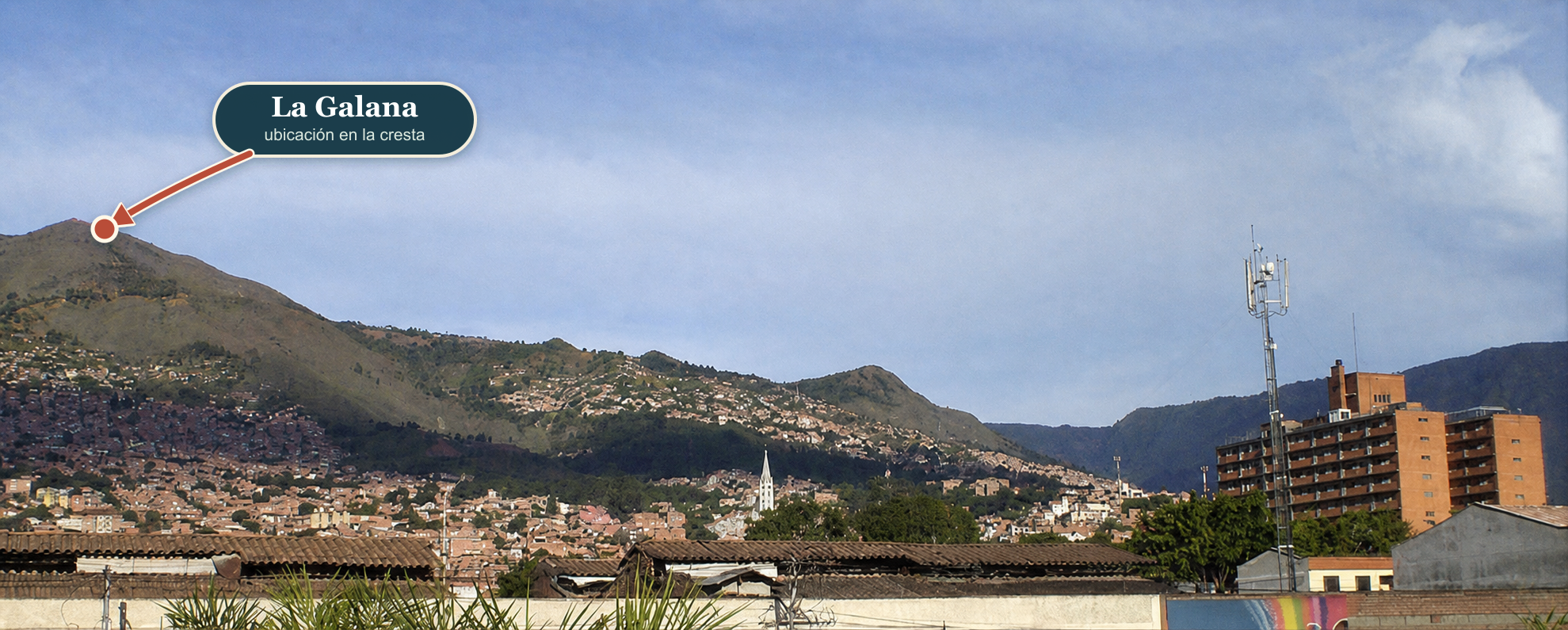
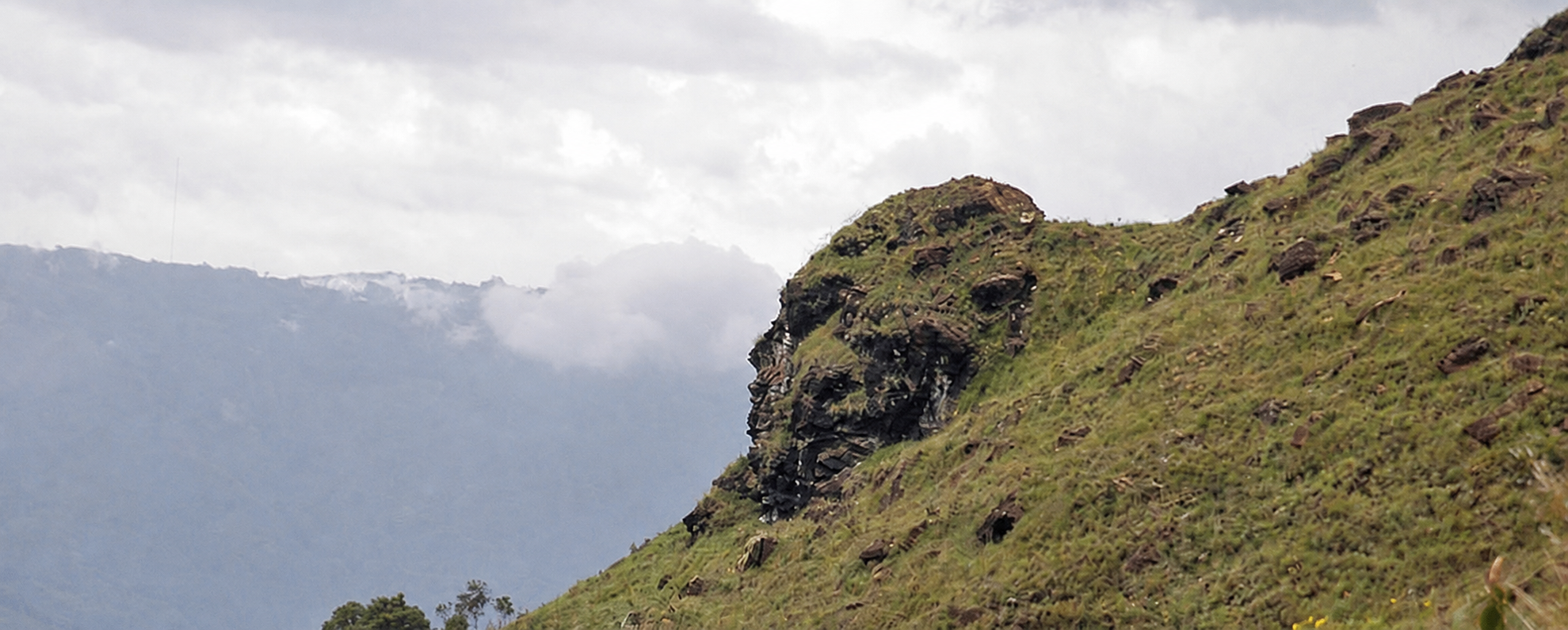
La Galana lies on the central-eastern slope of the Aburrá Valley, near old routes between Medellín and the Santa Elena highlands. The most cautious explanation of its origin is a natural geological formation with little or no recognisable human intervention. Its appearance alone is not evidence of carving, a monument or a constructed image.
A different question is what people travelling along the slope may have seen there. Landscape archaeology has shown that outcrops, mountains, caves and natural springs can acquire social value while remaining natural formations. That comparison opens hypotheses; it does not show that La Galana was sacred, venerated or named in the same way in the past.154, 155
Restored storyboard
The sequence retains the original approach: first discovering the formation within the hillside, then moving closer to its silhouette. The panorama comes from the original project’s photographic archive; the detail is based on a Proyecto AD photograph of La Galana, Aburrá Valley, 2007.153, 156
Territorial scale
Visibility depends on viewpoint, vegetation, the route taken and urban transformation. Today’s landscape guides the question, but does not reproduce pre-Hispanic experience exactly.
Perceptual scale
Recognising a face or silhouette may involve pareidolia: the human tendency to identify familiar forms. This explains part of its present visual effect without determining what other societies perceived.
Four possibilities
This would be a stronger hypothesis if there were offerings, traces of repeated visits, modified approaches or datable ritual associations. An imposing appearance does not prove sacred significance.
The profile may have prompted stories, names or memories. Without surviving Indigenous testimony or associated contexts, we cannot reconstruct what figure people saw or what story they told.
As a visible landmark beside a route, it may have guided journeys or prompted comparisons. The hypothesis must be tested against past visibility, the path’s alignment and evidence from the surroundings.155
It may also have been an everyday presence, recognisable but unexceptional. Contemporary wonder cannot automatically be projected onto those who lived with the hillside.
State of the evidence
Local scholarship has included La Galana in interpretations of pre-Hispanic architecture and spatial organisation. That inclusion keeps discussion open, but does not replace archaeological demonstration.128
In Medellín’s updated heritage inventory, Alto de la Piedra Galana appears in the landscape category. This contemporary classification does not demonstrate ancient indifference; it does require us to avoid presenting an unestablished ritual function or human modification as fact.157
Vancouver referencing