Spindle whorls, spiral lines and human-shaped vessels allow us to trace forms that recur across different objects and places. This exploration makes Proyecto AD’s comparisons visible, distinguishing observations, regional hypotheses and meanings that remain unknown.
Repetition does not reveal meaningForm starts the question; context limits the answer.
On this page
Before interpretation
From similarity to a testable hypothesis
The original narrative proposed looking for similarities among objects, petroglyphs and pottery. We retain that comparative approach while separating four operations: describing what is actually visible, recording where it occurs, comparing recurring features and proposing meanings. Only the last allows us to speak of messages, and it requires the greatest caution.
Fernando Urbina reminds us that an ancient graphic form can survive after its original connotations have been lost, and that each subsequent reading places it within a new constellation of meanings.204 His work demonstrates the value of bringing images, myth, ritual and spoken accounts together where relevant ethnographic traditions exist. By contrast, it also cautions that an Amazonian interpretation cannot automatically be transferred to the Aburrá Valley.
The most recent archaeological review stresses studying rock art through its contexts, settings and spatial relationships, rather than as an isolated collection of drawings.205 Here, that principle extends to portable objects: formal similarity becomes more persuasive when supported by provenance, chronology, technique and archaeological association.
01
Spinning · design · circulation
The spindle whorls of Guayabal
The assemblage takes us from the whorl’s technical function to a testable question: do regularities in decoration express individual decisions, shared learning or the circulation of design repertoires between the Aburrá Valley and neighbouring regions?
A simple, precise device
A spindle consists of a shaft fitted with a whorl. The weight stabilises rotation while the hand draws out and twists fibres to make thread. Comparative studies confirm this general function, but caution that weight, diameter and shape must be analysed together and within each regional context: no single measurement unambiguously identifies the fibre or the degree of production specialisation.206, 207
Educational reconstruction generated for Proyecto AD, 2026. The technical gesture is plausible; the person, clothing and landscape do not represent an excavation or a specific historical identity.
Aburrá Desconocido · Reading the archive
Spindle whorls: evidence of textiles, burial practices and symbolism in our past
An implement for making thread, an object placed with the dead and a surface bearing recurring forms. Together, these dimensions reveal the technical and social importance of textiles and offer a way to explore the visual languages of the societies that inhabited the Aburrá Valley.
01 · Textile technology
From rotation to thread
The whorl stabilises the spindle as fibres are twisted. Its presence provides evidence of spinning, one stage of textile production. Shape, weight and wear can help investigate how it was used; the photograph alone does not identify the fibre.206, 207
02 · Funerary context
Spinning accompanies the dead
Following Arcila, the multimedia project records 213 fired-clay spindle whorls in a tomb discovered at Guayabal in 1953, together with pottery, gold and stone objects. This association raises questions about the social and funerary value of textile implements.150
No secure absolute date for the burial is available here. Its context cannot be extended to every object being compared.
03 · An account of the conquest
The cloth wraps of Aburrá
Sardella’s account of the Spanish entry in 1541 describes a cloth wrap one and a half varas long and one vara wide. The garment covered part of the body; the chronicle also recounts the use of such wraps in hangings during the Spanish incursion.20
The passage documents cloth wraps and their dimensions; it does not specify the fibre.
From cultivation to weaving
The cotton production sequence
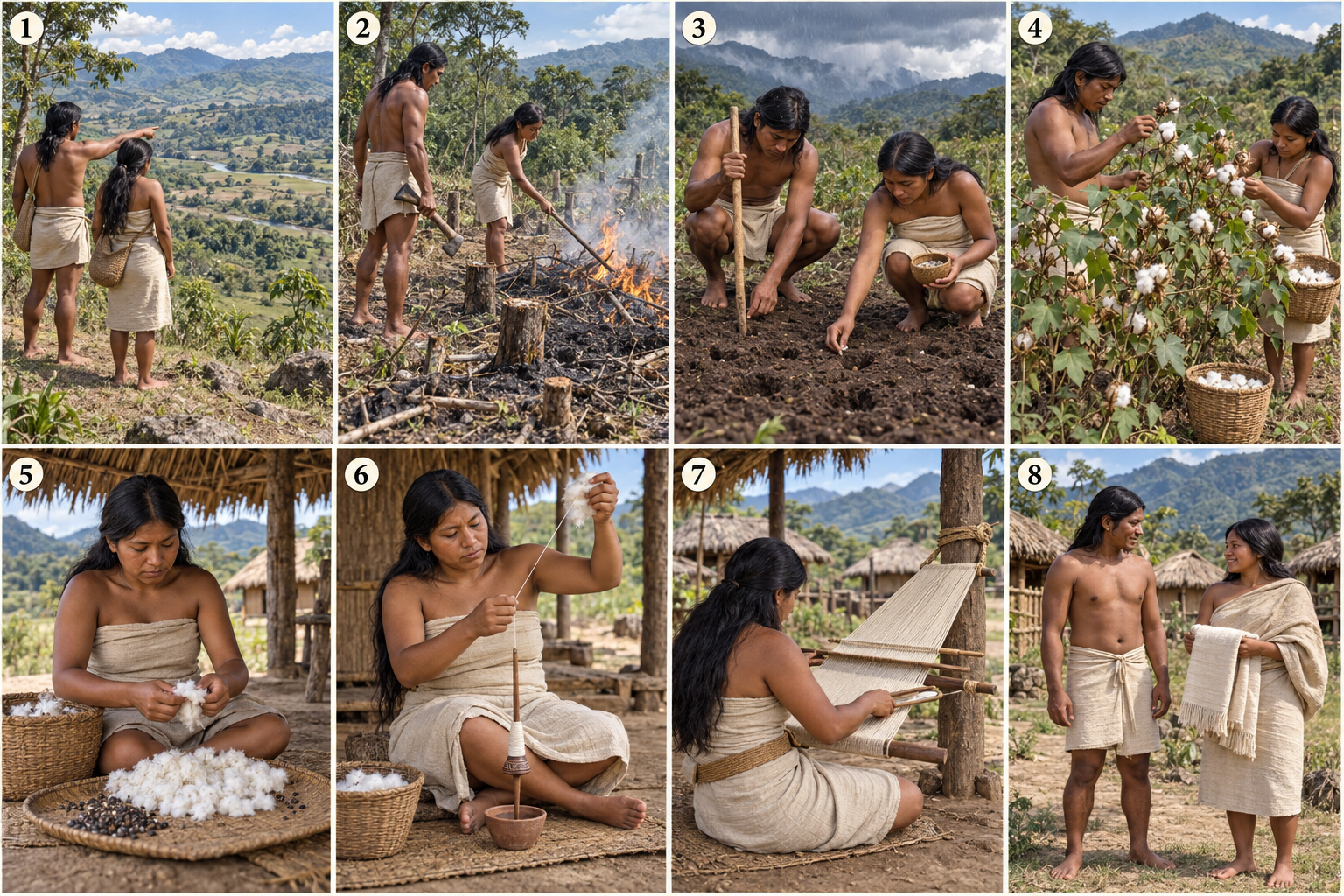
Eight stages for imagining cultivation, fibre preparation, spinning, weaving and the use of mantas and maures—cloth wraps and waistcloths—in pre-Hispanic Antioquia.
The production sequence in eight scenes. Select the illustration to enlarge it.
Direction and concept: Julián de Jesús Pérez Ríos, Proyecto AD. Illustration generated with OpenAI, 2026.
The sequence in motion. Animated clearing, harvesting and weaving, combined with the five remaining panels.
Direction and concept: Julián de Jesús Pérez Ríos, Proyecto AD. Illustration: OpenAI. Animations of stages 2, 4 and 7 and sound generated with Google Gemini. Editing assisted by Codex.
Interpretative recreation of a regional production sequence. Cotton need not have been grown in the Aburrá Valley itself. Identifying it as the fibre of Aburrá’s mantas and maures is the author’s inference; the cloth wrap tied at the waist is inspired by Sardella. The loom and additional clothing are interpretative reconstructions.
Read the eight stages
Selecting suitable land for cultivation.
Clearing and burning vegetation.
Sowing cotton in accordance with seasonal conditions.
Harvesting cotton.
Ginning: separating seeds from fibre.
Spinning with a spindle and whorl.
Producing textiles.
Wearing mantas and maures: cloth wraps and waistcloths.
Remembering local archaeology
Graciliano Arcila Vélez and the Guayabal discovery
Remembering Graciliano Arcila Vélez (1912–2002) means recognising a pioneer of Aburrá Valley archaeology and a teacher who helped establish its institutional foundations. His work connected research, collections and university education; in 1953, he promoted the publication of the Boletín de Antropología. The posthumous tribute Construyendo el pasado. Cincuenta años de arqueología en Antioquia, edited by Sofía Botero Páez in 2003, brought together assessments of that legacy. His memory also lives on in the work of those who revisit and share the evidence he documented.208, 209
In July 1953, Manuel Antonio Ortiz informed the Universidad de Antioquia’s Servicio Etnológico of graves on the Calabacera hilltop, now La Colinita, in Guayabal. Arcila visited the site and documented a tomb approximately five metres deep. His inventory, reproduced in Los Aburráes, records four ceramic objects, five gold nose ornaments and 213 spindle whorls, together with five stone implements, four stone pendants, three nodules of the same mineral, a quartz nodule and a fired-clay zoomorphic handle. He also recorded severely deteriorated human remains that could not be collected for assessment.31, 150
The discovery is significant because it brings spinning implements, ornaments and other objects together within a funerary context. Arcila classified the whorls by shape and studied their spiral or ‘sigmatic’ motifs. That record opened questions that remain fundamental to local archaeology: how threads were produced, what relationships the designs expressed and what value these objects held when accompanying the dead. Honouring his legacy means preserving that documentation and continuing the research it made possible.31
The surviving archive
Objects, three-dimensional forms and relationships
Select any image to enlarge it.
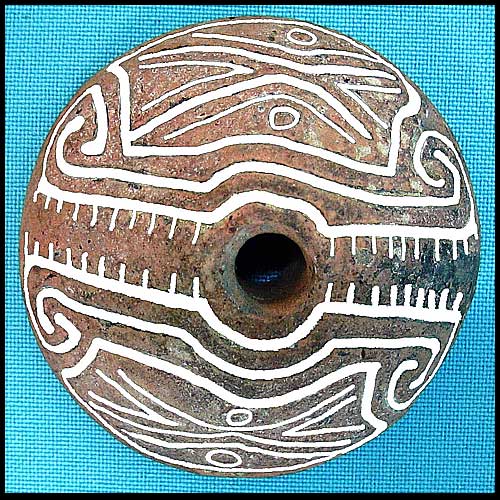
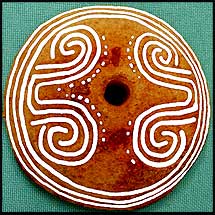
The Aburrá Desconocido multimedia project proposed identifying regularities despite changes in form, size and execution. Images from Guayabal and Jericó support that regional comparison. The examples brought together here allow the pattern and its variations to be examined.210
01 · Organising space around the spindle
Four curved fields surround the perforation. Lines and the spaces between them jointly create the composition.
Guayabal, Medellín. Photograph: Sofía Botero, 2006. White highlighting: Julián Pérez.02 · Designing in three dimensions
Bands, dots and curves are distributed across the body and neck. Decoration accompanies an object that is handled and rotated.
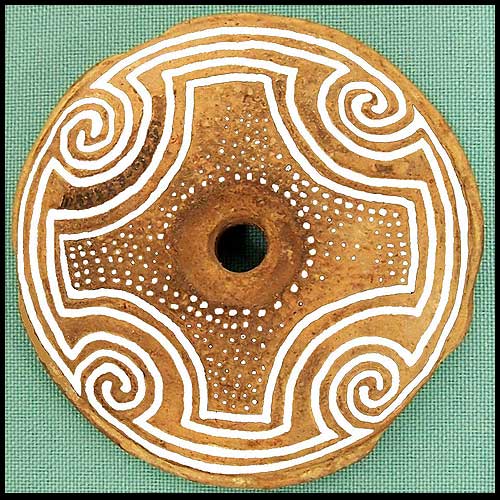
Guayabal, Medellín. Photograph: Sofía Botero, 2006. White highlighting: Julián Pérez.03 · Figure and ground
The outlines leave a cross-like central field around the hole. The design emerges through both the incisions and the relief.
Guayabal, Medellín. Photograph: Sofía Botero, 2006. Graphic analysis and highlighting: Julián Pérez.04 · Oppositions and bands
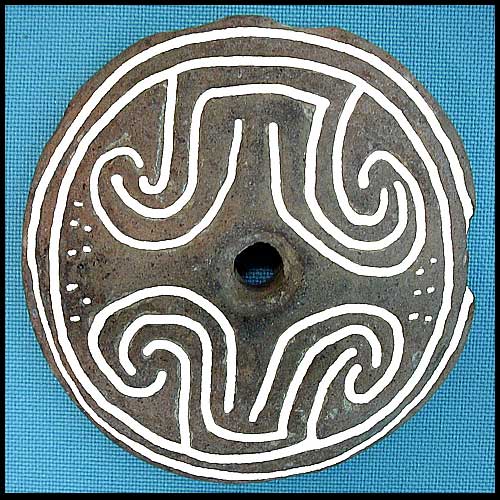
Two groups lie on either side of the perforation. Curved terminals, bands and short lines broaden the features available for comparison.
Aburrá Desconocido multimedia / Proyecto AD archive. White highlighting by Julián Pérez. Individual photographic credit and provenance remain to be established.05 · Comparison with Jericó
The arrangement of motifs allows shared relationships and local variants to be compared with Guayabal. The recreation is interpretive and should be checked against the reference photograph.
Interpretive AI recreation: Proyecto AD / OpenAI, 2026. Visual reference: Emilio Pineda, 2007. Jericó, Antioquia.06 · Repetition with variation
Four spiral terminals, bands and dots form an arrangement around the centre. Small differences are also part of the design.
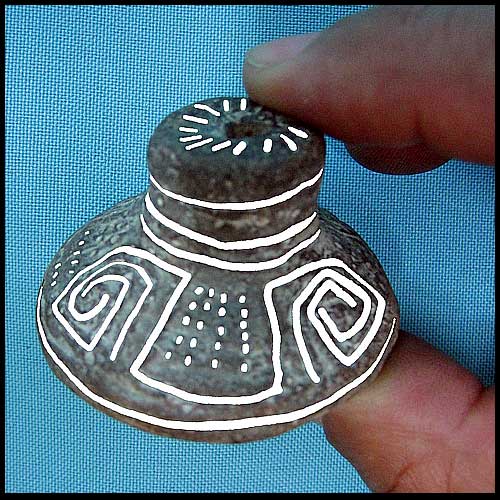
Aburrá Desconocido multimedia / Proyecto AD archive. White highlighting by Julián Pérez. Individual photographic credit and provenance remain to be established.07 · A truncated-cone form
The side view shows how curves adapt to the height and circumference of the body. The visible face reveals only part of their course.
Aburrá Desconocido multimedia / Proyecto AD archive. Individual photographic credit and provenance remain to be established.08 · Centre, edge and fields
A ring defines the centre; coiling curves and angular fields articulate its relationship with the edge. Tracing each line matters, as well as counting spirals.
Aburrá Desconocido multimedia / Proyecto AD archive. White highlighting by Julián Pérez. Individual photographic credit and provenance remain to be established.
One object · Two records
Making incisions legible
Careful highlighting makes the width and course of the incisions easier to see. This object shows how detailed reconstruction can reveal modelled and fired pieces bearing symbolism, with a functional role in spinning and a place in funerary contexts.210
White highlighting is a contemporary aid to interpretation. Authorship of the highlighting is distinguished from authorship of the photographs.
Without white highlighting
A photograph showing the grooves and the object’s surface.
Proyecto AD archive. Identification as the same object as whorl 15 confirmed by the author; individual photographic credit remains to be established.With white highlighting
The same object, with its incisions carefully highlighted at pixel level.
Aburrá Desconocido multimedia / Proyecto AD archive. White highlighting by Julián Pérez. Individual photographic credit and provenance remain to be established.
02
Topology and orientation
Opposite turns, enduring relationships
The pattern identified by the author brings together spirals unfolding in opposite directions from a starting point or chosen reading reference: one clockwise and the other anticlockwise. The comparison investigates this relationship between lines and how it recurs or changes in each composition.210
Follow the line
Record endpoints, continuity, separation, junctions and enclosed areas. An apparent crossing does not establish a connection; the chosen reading point does not identify the craftsperson’s first gesture either.
Read the fields
Observe how grooves and relief correspond, how they surround the hole and how they are arranged in halves or quarters. Some four-spiral compositions may bring together two paired units.
Compare the turns
Trace each line using the same convention, for example from the centre outwards. Orientation complements topology: rotating a photograph in its plane preserves the direction of coiling; mirroring it reverses that direction.
Here, topology concerns relationships of connection and separation. Clockwise or anticlockwise direction additionally requires an oriented reading of the surface.
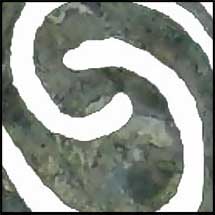
Detail · Angularity
Bends allow comparison of lines that retain a relationship even as their curvature changes.
Detail from the Proyecto AD archive. Graphic analysis by Julián Pérez; the source object is not individually identified in this crop.Detail · Separation
Two visible curved lines invite us to distinguish proximity from connection; the crop preserves only part of the field.
Detail from the Proyecto AD archive. Graphic analysis by Julián Pérez; the source object is not individually identified in this crop.Detail · Curvature
Alternation between line and surface makes the relationship between figure and ground visible.
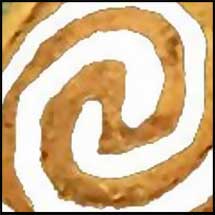
Detail from the Proyecto AD archive. Graphic analysis by Julián Pérez; the source object is not individually identified in this crop.Detail · Continuity
Following endpoints and the course of a line helps compare structure as well as visual resemblance.
Detail from the Proyecto AD archive. Graphic analysis by Julián Pérez; the source object is not individually identified in this crop.
These details are crops for comparison; they are not four additional objects and cannot, by themselves, establish provenance.
A proposal for investigation
From craft to shared memory
Whorls bring together technical knowledge and graphic choices. Their inclusion among grave goods shows that some also participated in funerary practices. It is reasonable to investigate whether they evoked crafts, relationships, affiliations or memories of the dead: these are interpretative possibilities, not meanings already deciphered.
The recurrence of oppositely turning pairs, together with their relationship to the centre, edge and raised fields, supports the proposal of a learned and shared visual repertoire. Comparing that combination between Aburrá and Jericó offers a way to explore regional cultural connections beyond isolated similarities. Research on Middle Cauca iconography provides a framework for studying the transmission and transformation of repertoires.141
The archaeological implements and the cloth wraps in the chronicle illuminate different periods and aspects of textile history. Reading them together gives depth to the question; establishing continuity between the Guayabal grave goods and the people described in 1541 will require further chronologies and contexts.
The original comparison continues
Motifs on other surfaces and objects
The Támesis petroglyph and the Middle Cauca ceramic vessel retain their place in this exploration. Comparing their forms with the whorls extends the question to landscape and other uses of images; each material setting requires its own context.127, 211
Támesis · A motif on rock
The pair of spirals extends the comparison to a fixed rock surface. Landscape, scale and technique must accompany the reading of similarities.
Interpretive AI recreation: Proyecto AD / OpenAI, 2026. Visual reference: Museo Universitario Universidad de Antioquia, Archivo Fotográfico Graciliano Arcila; CORANTIOQUIA, 2006.Middle Cauca · A motif on a vessel
Coiling curves and angular divisions recur in the interior band. The precise locality and context are not recorded in this archive.
Interpretive AI recreation: Proyecto AD / OpenAI, 2026. Visual reference: Museo del Oro, Banco de la República; Multimedia Aburrá Desconocido.
Thread joins fibres; research can reconnect implements, images, textiles and the memory of those who made them part of their lives and funerary practices.
Proyecto AD’s interpretative proposal, based on the Aburrá Desconocido multimedia project and its author’s clarifications.
03
Pottery · classifications · operational sequence
From clay to memory: pre-Hispanic pottery of the Aburrá Valley
Ten possible stages for reconstructing the manufacture of a small phytomorphic vessel found at La Morena (Envigado), distinguishing documented evidence, technical inference and working hypothesis.
From clay to memory: the operational sequence in ten possible stages. Select or tap the plate to enlarge it and read all ten panels on mobile or desktop devices. Didactic reconstruction inspired by the small phytomorphic vessel from La Morena, Envigado, described by Gustavo Santos Vecino (2011, p. 77, note 27; photograph 32b, p. 78), whose form and funerary association with an inverted bowl serving as a lid are documented (D), whereas the stages of raw-material procurement, paste preparation, shaping, drying, open firing and transport combine technical inferences (I) and working hypotheses (H).3
Direction and concept: Julián de Jesús Pérez Ríos, Proyecto AD. Archaeological reference: Santos Vecino (2011, pp. 77–78, photograph 32b). Illustration generated with AI assistance (OpenAI), 2026.
The sequence in motion · 1 min 33 s (1920 × 1080 px). Audiovisual didactic reconstruction of the ten possible stages of manufacture, use and deposition of the small phytomorphic vessel from La Morena, Envigado; the audiovisual set should not be interpreted as an exact archaeological reproduction, nor does it automatically attribute to this specific piece every technique documented on other ceramics from the site. Clip 8 (08 · Firing and cooling) displays a variation in vessel shape and decoration relative to the archaeological reference piece and retains on screen the explicit notice: “Esquema técnico · decoración no fiel al referente” (“Technical diagram · decoration not faithful to the reference piece”).
Direction and concept: Julián de Jesús Pérez Ríos, Proyecto AD. Animations and ambient sound generated with AI assistance (Google Gemini / OpenAI); editing and assembly assisted by AI, 2026. Ambient audio without voice-over narration.
Accessible description of the visual sequence and on-screen labels (ten stages)
Note on audio and text format: the video contains ambient sound only (water, kneading clay, fire and surroundings) and has no spoken narration. The list below provides an accessible description of the ten moving scenes based on the labels integrated into the plate and video, distinguishing between D · Documented (vessel form and find context), I · Technical inference (necessary steps in pottery making) and H · Hypothesis (recreated gesture, setting and conditions).
01 · Clay selection: selecting suitable clay from a moist hillside source (I · Procurement · H · Place and gesture).
02 · Paste preparation: cleaning, mixing with temper and kneading to obtain a workable paste (I · Preparation · H · Recipe and kneading).
03 · Shaping: hand-modelling the lobed body; joining clay coils is presented as a technical possibility (H · Proposed technique for this vessel).
04 · Partial drying: sheltered pause allowing the vessel to firm up before surface finishing (I · Technical pause · H · Time and place).
05 · Finishing and decoration: smoothing, pebble burnishing, slip application and black painting (D · Surface finishes · H · Tool and sequence).
06 · Pre-firing drying: resting the vessels to reduce residual moisture before exposing them to fire (I · Drying · H · Arrangement and duration).
07 · Firing preparation: placing the vessel over firewood and ceramic sherds in a possible fuel arrangement (I · Preparation · H · Open firing).
08 · Firing and cooling: open bonfire firing and subsequent cooling; the edit condenses two distinct moments (I · Thermal process · H · Conditions). On-screen notice: “Esquema técnico · decoración no fiel al referente” (“Technical diagram · decoration not faithful to the reference piece”), as this clip shows a variation in shape and decoration compared with the reference phytomorphic vessel.
09 · Circulation and use: carrying the finished vessel; its final funerary destination is known, whereas prior uses remain unproven (D · Funerary context · H · Transport).
10 · Deposition and permanence: placing the vessel in a circular pit beside a dwelling structure at La Morena, covered with an inverted bowl as a lid (D · Association · H · Gesture and setting).
Pre-Hispanic pottery from the Aburrá Valley makes it possible to investigate technical knowledge, everyday practices and social relations. Cancana, Ferrería and Marrón Inciso are archaeological designations constructed by comparing pastes, vessel forms, surface finishes and decorations. Cancana is linked to early pottery traditions recognised in the Medellín–Porce river basin and at valley sites such as La Morena and Pajarito. However, these categories must not be automatically turned into the names of distinct peoples or into three successive, mutually exclusive stages. The coexistence of Ferrería and Marrón Inciso materials has received different interpretations: socially differentiated groups interacting with one another, a single population producing several styles, or transformations in potting practices over time. Santos interprets styles as media for communicating social differences, while acknowledging the difficulty of separating numerous undecorated or non-diagnostic sherds.3
From other perspectives, Botero and Vélez questioned both the mechanical repetition of established classifications and the creation of isolated categories for each site; Obregón examined the assumptions underlying those designations and the historical interpretations built upon them. These critiques invite us to ask what each classification actually explains and to test it against find contexts, radiocarbon dates and processes of production, circulation and use.114, 246 Raw-material research offers a complementary avenue: petrographic and zircon U-Pb analyses of ceramics from La Morena point to at least three geological provenances, revealing information that vessel appearance alone cannot resolve.247 The small vessel that inspires our plate and video illustrates these limits: Santos assigned it to Ferrería while noting features shared with Marrón Inciso. Accordingly, we present its operational sequence as a didactic reconstruction of plausible procedures, clearly distinguished from its documented form and funerary context.3
04
Body · vessel · funerary memory
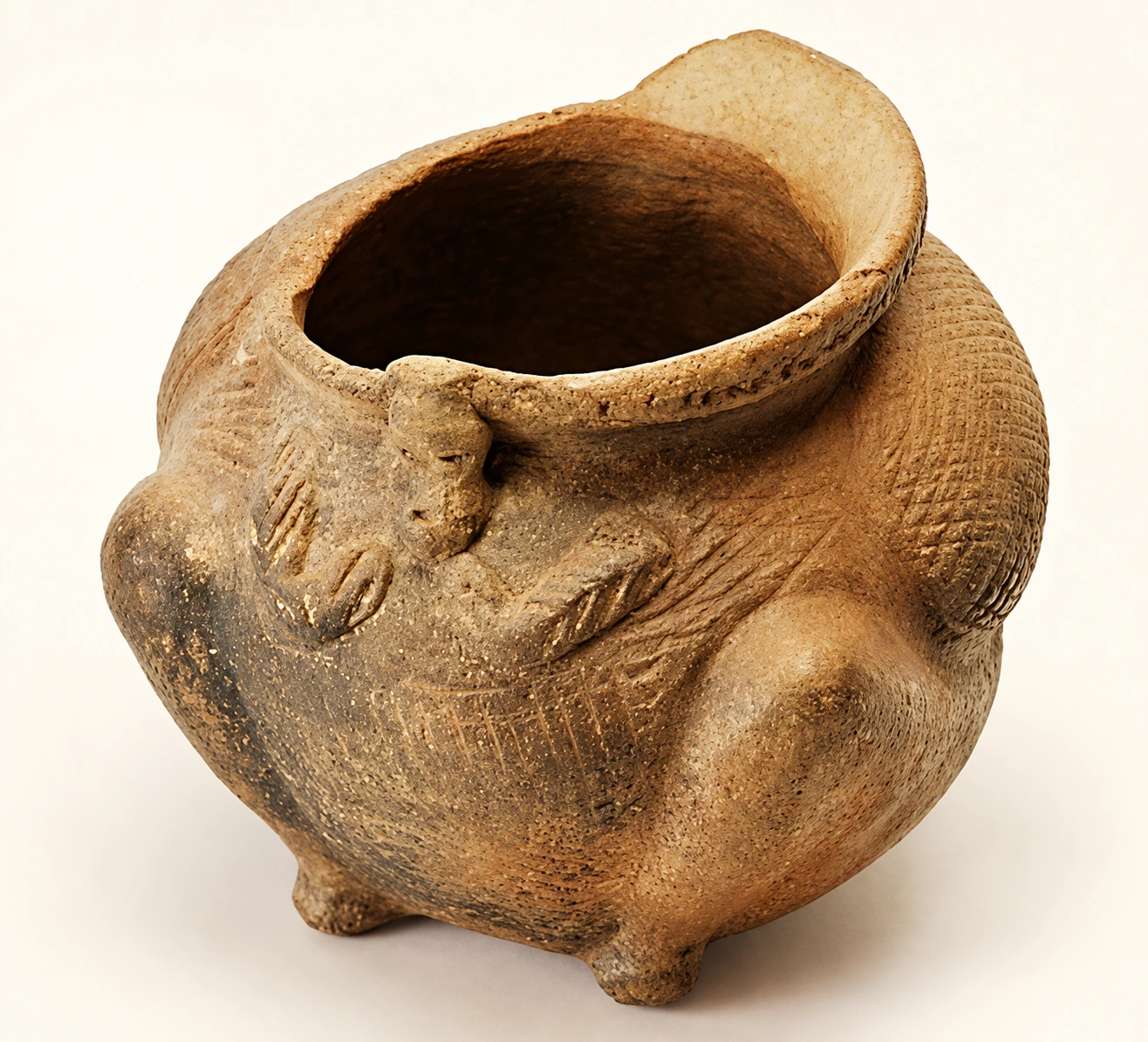
Schematic female forms: a religious symbol behind funerary patterns?
The question is examined through eight objects: first, observable bodily features are distinguished; next, provenance and funerary associations are checked; finally, their regional distribution is assessed as possible evidence of shared symbolism.
Central question · form, burial and regional extent
In July 1954, pre-Hispanic tombs were discovered during earthmoving for a health centre in Manrique Oriental, Medellín. Arcila managed to document traces of at least two burials. In a pit approximately 80 centimetres deep, an 18-centimetre vessel contained small fragments of cremated long bones; the project interpreted it as an urn associated with a secondary burial.150 This direct association raises the question of whether the female figure participated in a particular way of relating body, container and death.
The comparison brings together objects attributed to Medellín, Salento, Manizales, Santa Fe de Antioquia, Venecia and Támesis, alongside two vessels with no recorded provenance. This geography relates to the Middle Cauca, now understood as an archaeological region with diverse historical trajectories, rather than the homogeneous territory of a single culture.212 In Venecia, Arcila also documented a funerary urn with cremated remains and a female anthropomorphic vessel.213 This second association does not establish that the anthropomorphic vessel contained human remains, but again makes the relationship between female representation and the funerary sphere archaeologically relevant.
The series retains a bodily grammar while varying in volume and abstraction: frontality, bent arms, hands held near the torso, a division across the abdomen, modelled legs and anatomical features interpretable as female. Iconographic studies of the Middle Cauca connect female images, containers, life, transformation and processes of social change.141, 214 Those studies support the relevance of a symbolic or religious interpretation, but do not identify a particular deity or demonstrate that all the vessels were funerary, contemporary or understood in the same way. The hypothesis requires a more comprehensive compilation of chronologies, contexts, technologies and contents.
Observable features proposed in the project
a modelled, reduced or suggested head near the vessel’s opening;
bent arms and hands held open or close to the torso;
visible, vestigial or absent breasts, depending on the degree of schematisation;
a marked navel on several examples;
a transverse line below the abdomen;
modelled legs that also visually support the vessel;
bands or bindings at some joints;
a vertical line in the genital area, interpreted by the project as a marker of female sex.
Comparative gallery
Eight vessels, eight levels of information
Collection credits and provenance are retained as recorded.
1 · Medellín
The globular body retains arms and legs in relief; the head and hands are reduced near the opening. This is the only object in the series whose cremated contents and funerary context are described in Arcila’s text.
Interpretive AI recreation: Proyecto AD / OpenAI, 2026. Medellín, Antioquia. Anthropology Collection, Museo Universitario, Universidad de Antioquia. Reference photograph: Sofía Botero Páez, 2006.2 · Salento
The frontal figure integrates face, breasts, open hands, abdomen, knees and feet. Incised fields at the sides frame the body, making this the clearest reference for comparing more schematic versions.
Interpretive AI recreation: Proyecto AD / OpenAI, 2026. Based on the reference photograph of the vessel from Salento, Quindío. Anthropology Collection, Museo Universitario, Universidad de Antioquia.3 · Unknown provenance
The face, hands, knees and feet remain three-dimensional within a densely incised surface. The absence of a findspot prevents its use as evidence of distribution, chronology or function.
Interpretive AI recreation: Proyecto AD / OpenAI, 2026. Unknown provenance; credit retained from the original project. Reference photograph: Óscar Botero, 2004 (IDEA).4 · Unknown provenance
This representation has the fullest bodily volume in the series: face, torso, hands, abdomen and legs are integrated with the vessel. Without provenance, it is not placed on the map.
Interpretive AI recreation: Proyecto AD / OpenAI, 2026. Unknown provenance. Anthropology Collection, Museo Universitario, Universidad de Antioquia. Reference photograph: Óscar Botero, 2004 (IDEA).5 · Manizales
The frontal scheme remains legible, but detail and contrast between figure and vessel diminish. Arms, hands, knees and the division across the abdomen sustain the comparison.
Interpretive AI recreation: Proyecto AD / OpenAI, 2026. Manizales, Caldas. Anthropology Collection, Museo Universitario, Universidad de Antioquia. Reference photograph: Óscar Botero, 2004 (IDEA).6 · Santa Fe de Antioquia
The face is reduced beneath the rim and the limbs become elongated volumes. Comparison rests on the relative arrangement of parts, not naturalistic resemblance.
Interpretive AI recreation: Proyecto AD / OpenAI, 2026. Santa Fe de Antioquia. Museo del Oro Collection, Banco de la República. Reference photograph: Óscar Botero, 2004 (IDEA).7 · Venecia
The small head sits between curved arms; the legs and central line dominate the lower half. In this area, Arcila recorded an urn with cremated remains and a female anthropomorphic vessel: a relevant regional association, though not equivalent to the Medellín object.
Interpretive AI recreation: Proyecto AD / OpenAI, 2026. Venecia, Antioquia. Anthropology Collection, Museo Universitario, Universidad de Antioquia. Reference photograph: Óscar Botero, 2004 (IDEA).8 · Támesis
The figure is integrated into the container through a minimal head, indicated hands, large lateral volumes and incised lines. Its provenance places it within the regional core where petroglyphs are also concentrated.
Interpretive AI recreation: Proyecto AD / OpenAI, 2026. Támesis, Antioquia. Anthropology Collection, Museo Universitario, Universidad de Antioquia. Reference photograph: Óscar Botero, 2004 (IDEA).
What is supported
The series reveals a regional convention for representing the body: several anatomical relationships recur from the Aburrá Valley to the Middle Cauca. The Medellín funerary association and the joint record of an urn with cremated remains and a female vessel in Venecia give the comparison archaeological substance.213
What needs qualification
‘Female’, ‘urn’ and ‘secondary burial’ are plausible readings where represented anatomy, contents and context converge. For museum objects, the female-form hypothesis can be assessed formally, but a funerary function must not be extended to them without documentation.
What is not demonstrated
The shared repertoire does not establish ‘the same woman’, a single deity or a homogeneous population. The stronger hypothesis is a regional visual grammar; identifying its precise meaning requires comparable chronologies, technologies and associations.
In pre-Hispanic art, a recurring form can indicate memory, convention, technical learning or regional circulation. Choosing among those possibilities requires context.
Editorial comment by Proyecto AD. Research on the rock-art landscapes of Támesis, Jericó and Pueblorrico reinforces the need to read images through their settings and spatial relationships.211
05
Provenance · recurrence · corridors
The geography of a shared hypothesis
The map focuses exclusively on anthropomorphic vessels with known municipal provenance. It does not draw a cultural boundary: it shows the discontinuous extent of a bodily scheme across the Aburrá Valley, the Antioquian Cauca region and the Middle Cauca, helping assess how much of that distribution supports a symbolic and funerary hypothesis.
Each dark point locates a municipal centre. A line connects it to its vessel; thumbnails are offset for legibility. Enlarge the map to explore the spatial relationships.
Map 1 · Comparative distribution of known provenances. Departmental base map: DANE, Marco Geoestadístico Nacional 2024.215 Points were calculated within the urban areas of the six municipal centres, using DANE’s MGN 2025. They are municipal reference locations, not exact excavation sites. The base map and points share the same projection; the grid and scale allow positions and distances to be compared. Lines connect images to their locations only: they do not represent ancient routes. The two vessels without provenance and the Middle Cauca pottery without a precise locality are deliberately excluded. Boundaries are cartographic; they do not represent pre-Hispanic frontiers.
What supports the hypothesis
A regional bodily grammar
Recurrence is not confined to one municipality: known provenances form a spatial sequence from Medellín and the Antioquian Cauca region to Manizales and Salento. The repetition of several bodily relationships—not just one detail—the direct funerary association documented in Medellín, and the regional co-occurrence of an urn with cremated remains and a female anthropomorphic vessel in Venecia support the argument that these images may have been culturally intelligible within regional networks. Studies of the Middle Cauca show that ceramic and metal iconographies participated in systems of thought and long-term social transformations.141, 213, 214
What it does not yet demonstrate
A single culture or ‘the same woman’
The map does not make undated objects contemporary or turn resemblance into ethnic identity. ‘Shared culture’ here means a visual repertoire that may have circulated through learning, exchange, mobility and funerary memory; it does not mean a homogeneous society, a single goddess or an identical religion. Distinguishing these possibilities requires dates, technological analyses, clay provenances and comparable funerary associations.
The productive question
What relationship did the image create?
If the container held or accompanied cremated remains, the figure was more than decoration: it made visible a relationship between body, vessel and treatment of the dead. Did it represent the buried person, a female principle, a female ancestor, a body conceived as a container or a category now inaccessible to us? The map makes the question spatially testable, but answering it will require more comprehensive compilations and analytical research.
References
Vancouver referencing · numbers follow first appearance across the project. A repeated source retains the same number; this section’s list is a subset of the project bibliography.
Santos Vecino G. Investigaciones arqueológicas en El Escobero, municipio de Envigado (Antioquia) [Internet]. Envigado: Archivo Histórico, Secretaría de Educación para la Cultura, Municipio de Envigado; 2011 [cited 2026 Sep 20]. Relevant passages for pottery and the La Morena phytomorphic vessel: pp. 68–71; p. 77, note 27; photograph 32b, p. 78. Available from: https://patrimonioculturalenvigado.edu.co/Documentos/4.InformeFinalMorena.pdf View source
Sardella JB. Relación del descubrimiento de las provincias de Antiochia por Jorge Robledo [account dating from 1541]. Passage reproduced and adapted in: Llano Restrepo MA. La fundación de Medellín: recuento cronológico, controversias y documentos. Repert Hist [Internet]. 2025;(211):41-43 [cited 2026 Oct 1]. Available from: https://historiantioquia.org/wp-content/uploads/2026/01/Academia-Antioquena-de-Historia-Repertorio-Historico-211-julio-diciembre-2025-web-pagina-individual.pdf View source
Aristizábal Espinosa P. Los Aburráes: tras los rastros de nuestros ancestros. Una aproximación desde la arqueología. 1st ed. Medellín: Alcaldía de Medellín, Secretaría de Cultura Ciudadana; 2015. ISBN: 9789588845340. Guayabal inventory: p. 34-37. Digital copy consulted on Scribd; the colophon dates the first edition to April 2015, whereas the Google Books record gives 2014. View source Additional link
Obregón Cardona M. De los tiestos a los textos: elementos para un análisis al respecto de las categorías clasificatorias de la cerámica arqueológica en Antioquia. Bol Antropol. 1999;13(30):166-178. doi:10.17533/udea.boan.337514. Original 1999 print publication (distinct from its later digital repository upload). View source
Cieza de León P. Crónica del Perú. 1553. Chapters XVII and XXXV. Extracts transcribed in: Pedro Cieza de León describe el camino entre Urabá – Antioquia – Valle de Aburrá y Arma en su Crónica del Perú de 1553. Albicentenario [Internet; cited 2026 Oct 8]. The passage on cotton clothing concerns regional exchange by merchants from Mungia. View source
Martínez LE, Hernández HJ, et al. Identificación y caracterización del patrimonio rupestre asociado a las áreas naturales de la jurisdicción de Corantioquia. Medellín: Corporación Autónoma Regional del Centro de Antioquia; 2006. Final report.
Piazzini Suárez CE. Cambio social en la cuenca media del río Cauca, Colombia (3000-400 a. P.): una aproximación desde las iconografías arqueológicas. Bol Antropol. 2015;30(50):55-93. doi:10.17533/udea.boan.v30n50a03. View source
Arcila Vélez G. Introducción a la arqueología del Valle de Aburrá. Medellín: Universidad de Antioquia, Museo Universitario; 1977. View source
Urbina F. El hombre sentado: mitos, ritos y petroglifos en el río Caquetá. Boletín Museo del Oro. 1994;(36):67-111 [Internet; cited 2026 Aug 23]. Available from: https://publicaciones.banrepcultural.org/index.php/bmo/article/view/6989 View source
Argüello García PM. Arqueología del arte rupestre en Colombia. Arqueología y Patrimonio. 2025;5(1):58-81. doi:10.22380/26652773.3004. View source
Banco de la República. Volante de huso troncocónico, registro C13658 [Internet]. Colección Arqueológica de los Museos del Oro; [date unknown] [cited 2026 Aug 23]. Available from: https://colecciones.banrepcultural.org/es/documento/volante-de-huso-tronco-conico/63a069165d96b8790f34936d View source
Giraldo HJ, Gutiérrez S, Ledesma L. Variabilidad en la producción de hilados en las sociedades prehispánicas del suroccidente colombiano. Boletín del Museo Chileno de Arte Precolombino. 2026;31(1):94-111. doi:10.56522/BMCHAP.0070010310006. View source
Universidad de Antioquia. Sala Graciliano Antonio Arcila Vélez [institutional biographical sketch on the Internet; cited 2026 Sep 27]. Stated sources: university employment archive and history of Editorial Universidad de Antioquia. View source
Jaramillo E LG. Arqueología en Antioquia y el nuevo milenio: comentarios en torno a 50 años de investigación [review of Construyendo el pasado. Cincuenta años de arqueología en Antioquia, 2003 special edition edited by Sofía Botero Páez]. Boletín de Antropología. 2004;18(35):415–434, especially p. 415–416. doi:10.17533/udea.boan.7054. The review documents the posthumous tribute and reports on Carlo Emilio Piazzini’s essay ‘Graciliano Arcila y la arqueología en Antioquia’ (2003:17–40). View source Additional link
Pérez J, Proyecto AD. Aclaraciones del autor sobre el registro de volantes, el marcado blanco de las incisiones, la identidad de min_volante15 y min_volante16 y el patrón de giros opuestos [personal communications, 2026 Sep 27]. Checked against the retained script and images of the multimedia work Aburrá Desconocido (2007).
Gómez García AN, Flórez Fuya F. Los petroglifos y el paisaje prehispánico en Támesis, Jericó y Pueblorrico (Antioquia). In: Argüello García PM, editor. Arte rupestre en Colombia. Tunja: Editorial UPTC; 2018. p. 43-76. doi:10.19053/9789586603263.9789586604345. View source
Banco de la República. Museo del Oro Quimbaya: milenios de historia en el Cauca Medio [Internet]. Bogotá: Banrepcultural; [date unknown] [cited 2026 Aug 23]. Available from: https://enciclopedia.banrepcultural.org/Museo_del_Oro_Quimbaya View source
Arcila Vélez G. Introducción al estudio arqueológico de los Titiribíes y los Sinifanáes, Antioquia, Colombia. Boletín de Antropología. 1969;3(11):17-69 [Internet; cited 2026 Aug 23]. Available from: https://revistas.udea.edu.co/index.php/boletin/article/download/341405/20795879/187936 View source
Uribe Villegas MA. Mujeres, calabazos, brillo y tumbaga. Símbolos de vida y transformación en la orfebrería Quimbaya Temprana. Boletín de Antropología. 2005;19(36):61-93. doi:10.17533/udea.boan.6916. View source
Departamento Administrativo Nacional de Estadística. Marco Geoestadístico Nacional 2024: capa Departamento [geographic service]. Bogotá: DANE; 2024 [Internet; cited 2026 Aug 23]. Available from: https://portalgis.dane.gov.co/mparcgis/rest/services/MGN2024/Serv_CapasMGN_2024/FeatureServer/319 View source
Botero Páez S, Vélez Escobar N. Algunas reflexiones sobre el registro cerámico arqueológico en Antioquia. Bol Antropol. 1995;9(25):100-118. doi:10.17533/udea.boan.343761. Original 1995 print publication (distinct from its later digital repository upload). View source
Weber M, Valencia V, Caballero J, Villada B, Cardona A, Iizuka F. U-Pb dating of zircon: A sourcing method for pottery from La Morena archaeological site, north-west Colombia. Archaeometry. 2020;62(3):439-468. doi:10.1111/arcm.12532. Study on the geological provenance of ceramic raw materials, not a direct dating of vessel manufacture. View source